

Before an application for probate can be filed, the Uniform Civil Procedure Rules require the executor to publish a notice of intention to apply in the Queensland Law Reporter, wait 14 days to allow objections, and wait at least 7 days after the Queensland Public Trustee receives a copy of that notice (Queensland Courts, checked August 2026). The earliest a straightforward application can be filed is therefore roughly two weeks after publication. Queensland Courts does not publish an indicative Registry turnaround, so the filing-to-grant portion should be confirmed with the Supreme Court of Queensland registry rather than assumed. The grant is not the end: calling in estate assets, paying debts and distributing to beneficiaries usually adds months.
Key takeaways
- How long probate takes in QLD is set by two stages: the steps required before filing, and the Registry’s review after filing.
- Two waiting periods run before filing: 14 days from publication in the Queensland Law Reporter, and 7 days from the Public Trustee receiving the notice.
- Those two clocks can start on different days. The later of them controls your earliest filing date.
- A grant authorises the executor to begin or complete many estate-administration tasks; it does not finish the administration.
- Court fees and waiting periods change, so confirm current figures with Queensland Courts before you rely on a date.
How long does probate usually take in Queensland?
For a straightforward application, the pre-filing portion is fixed and knowable: allow at least 14 days from publication of the notice, and at least 7 days from the Public Trustee’s receipt of it, before the application for probate can be lodged (Queensland Courts, checked August 2026). The filing-to-grant portion is the part nobody can promise you. Queensland Courts publishes the procedure and the forms but does not publish a current Registry turnaround figure, so any firm quoting you an exact number is estimating, not citing. Ask the Probate Registry what it is running at when you are ready to file.

The completeness of the application is one important influence on the time between filing and grant. Applications that arrive complete and correct move through the Probate Registry without intervention. Applications with a gap, an inconsistency or a missing document attract a requisition, which delays the application until the requested material is supplied. Probate is granted under the Succession Act 1981 (Qld), following the procedure in chapter 15, part 2 of the Uniform Civil Procedure Rules 1999 (Qld), and the Registry checks every application against those rules before it seals a grant.
This page deals only with timing: notice-to-filing, filing-to-grant, requisition delays, and grant versus administration. For what probate is, who can apply, and whether a particular estate will require probate at all, see our deceased estates and probate page.
What are the stages that make up the timeline?
Probate is a legal process made up of stages, not a single waiting time, and several of them can run at once. Knowing which ones overlap is where an organised executor recovers weeks.
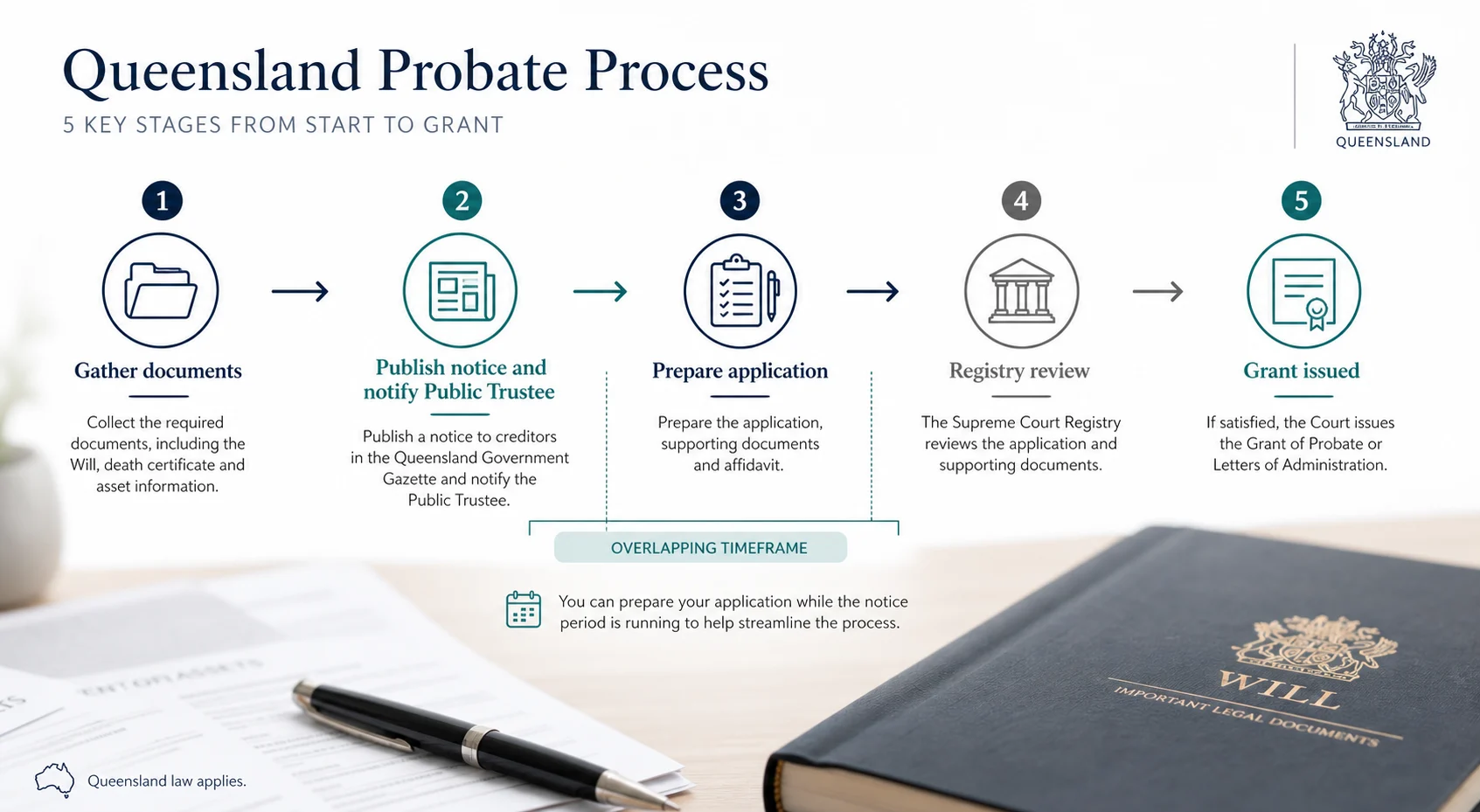
| Stage | What happens | What drives the time | Can this overlap another stage? | What the executor can prepare now |
|---|---|---|---|---|
| Gathering documents | Locate the original will, obtain the death certificate, list assets and liabilities | How organised the deceased’s affairs were, and how fast the death certificate is issued | Yes, with the notice period | Check that the name on the will matches the death certificate exactly, and note any variation |
| Advertising the notice | Publish the notice of intention to apply in the Queensland Law Reporter and send a copy to the Public Trustee | Two fixed waiting periods must elapse | Yes, everything else runs alongside it | Diarise both dates: 14 days from publication, 7 days from Public Trustee receipt |
| Preparing the application | Draft the application and supporting affidavits, arrange swearing | Executor availability and estate complexity | Yes, during the notice period | Compile what each of the financial institutions requires, and confirm the current filing fee |
| Filing and Registry review | Lodge with the Supreme Court Probate Registry | Registry workload and whether a requisition is raised | No | Have the executor available to answer a requisition quickly |
| Grant issued | The Court seals the grant of probate | Nothing further, once any requisition is cleared | No | Prepare the letters asking asset holders to release funds |
As at August 2026, the filing fee for an application for a grant is $847.60 under the Queensland Courts civil court fees schedule. Check the current schedule before filing, because fees are reviewed periodically.
How long is the notice period before you can file?
After publishing the notice and giving the required notice to the Public Trustee, the executor must wait the prescribed periods before they can apply for probate. As at August 2026, Queensland Courts states that you must wait 14 days after publication in the Queensland Law Reporter to allow objections, and at least 7 days after the Queensland Public Trustee receives the notice, subject to the precise calculation required by the rules. The Queensland Law Reporter is the publication approved for giving notice of intention to apply under chapter 15, part 2 of the Uniform Civil Procedure Rules 1999 (Qld).
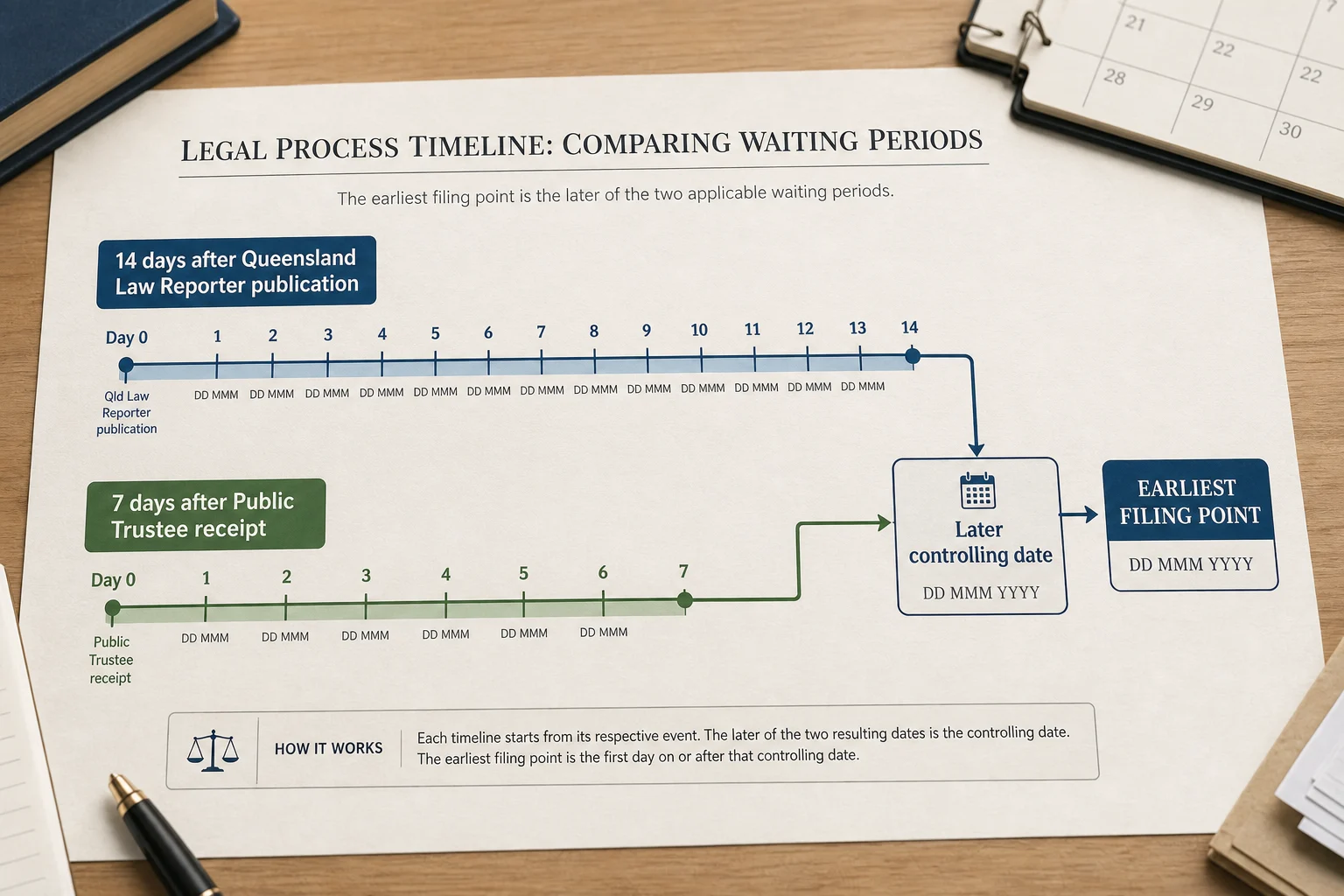
The notice alerts interested parties that an application for a grant is proposed. Separate procedures and time limits can affect creditor claims and the safe distribution of the estate.
Here is where executors lose time without realising it. The two periods do not necessarily start on the same day. If the notice is published on Friday 7 August and the Public Trustee receives its copy the same day, the 7-day period expires well before the 14-day period, so publication governs and the earliest filing day falls in the week beginning 24 August once the intervening weekend is accounted for. If the Public Trustee’s copy is sent late, say a week after publication, the 7-day period becomes the controlling one and pushes filing back accordingly. Sending the copy to the Public Trustee promptly can help prevent the 7-day period from extending the earliest filing date.
These periods are fixed by the rules, not by how busy you are. They run whether you file on the first permitted day or a month later. Publish early: executors routinely spend weeks assembling asset information they could have gathered while the notice period was already running.
How long does the Registry take once the application is filed?
Once a complete application is filed, the Probate Registry reviews it on the papers and, if everything is in order, issues the grant. There is no hearing for a standard probate application. Because Queensland Courts does not publish a current turnaround figure, treat any number you are given as an estimate and confirm it with the Registry at the time you file.
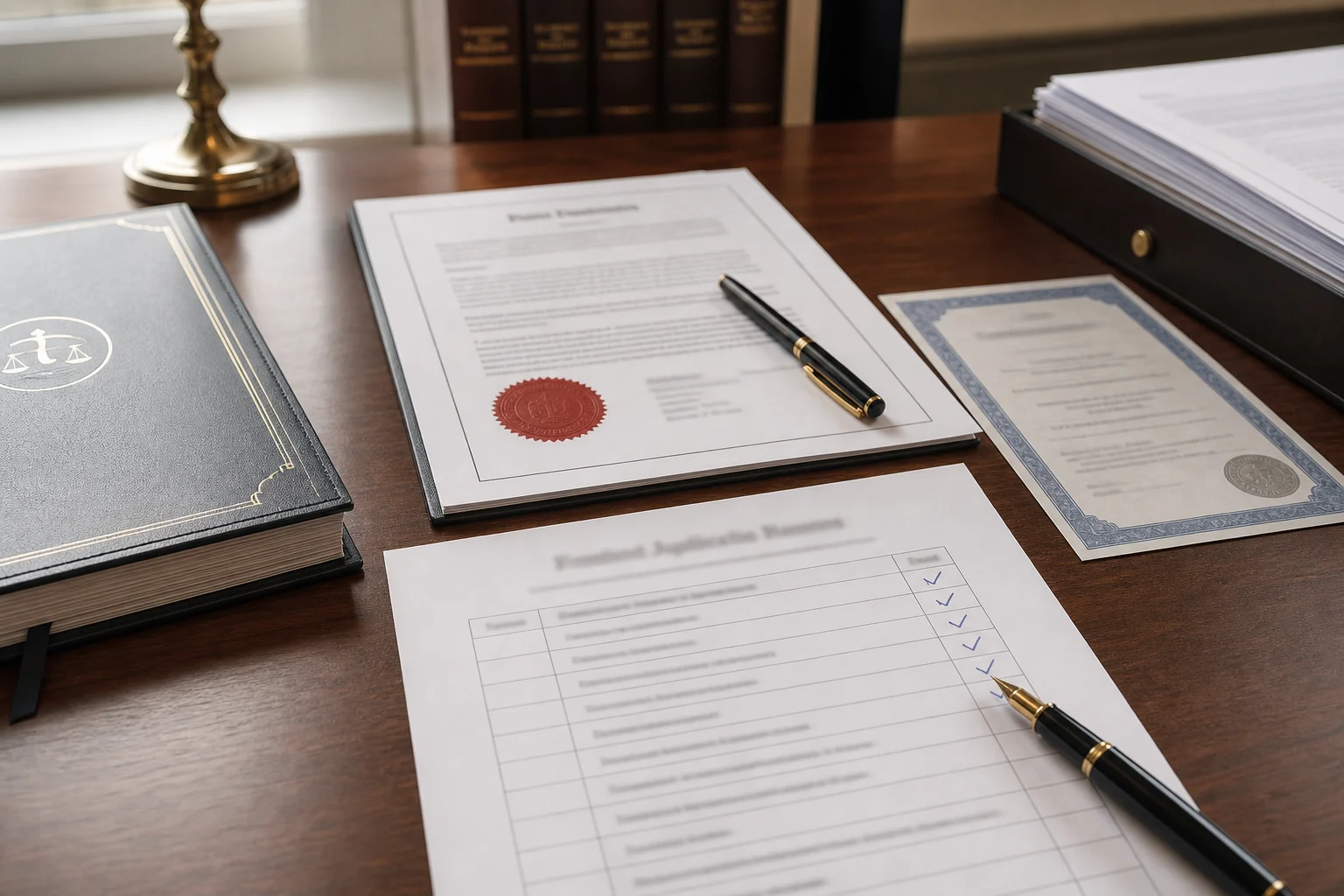
If the Registry finds a problem, it issues a requisition: a formal request to fix or explain something before the Court can grant probate. Common triggers include a will that has been stapled and unstapled (raising a question about whether a document was attached and removed), an inconsistency between the will and the death certificate, an unexplained alteration on the will, or a missing affidavit. Each requisition pauses the application until you respond, and a poorly handled response can generate a second one. Checking the will, death certificate, affidavits and filing material for discrepancies before lodgement can reduce avoidable requisitions.
The table below sets out issues that commonly prompt a question from the Registry and the kind of material usually needed to answer it. It is a general guide only: what is actually required depends on the will, the estate and the terms of the requisition itself.
| Issue noticed | Why the Registry may ask about it | Material commonly needed |
|---|---|---|
| Name discrepancy between the will and the death certificate | The Court must be satisfied the person who made the will is the person who died | An affidavit explaining the variation, with supporting identity or marriage documents |
| Staple or pin marks on the will | Raises the question of whether another page or document was once attached and removed | An affidavit from a person with knowledge of the will’s condition, addressing what was attached |
| Handwritten alterations or unexplained markings | Alterations made after signing are not usually effective without proof | An affidavit from an attesting witness or another person able to say when the change was made |
| The original will cannot be produced | A missing original may raise a presumption that the will was revoked | An affidavit dealing with the search made and the will’s last known location, and usually a separate application to prove a copy |
| The named executor cannot or will not act | The Court needs to know who is properly entitled to the grant | Evidence of death, renunciation or inability to act, and an application for letters of administration with the will |
What causes probate to take longer than expected?
Several situations reliably make the probate process take longer than the straightforward case:

- The original will cannot be found. A copy will not do without further steps. Proving a lost or copy will requires additional affidavit evidence and, often, a separate application.
- No executor is able to act. If the named executor has died, renounced, or cannot be located, the estate needs a grant of Letters of Administration with the will instead, which follows a different appointment process.
- There is no valid will at all. Intestacy calls for Letters of Administration and the identification of who is entitled to apply, which takes longer to prepare.
- The will is unclear or was altered. Handwritten changes, unsigned pages, or informal documents invite requisitions.
- The estate is complex. Assets held interstate or overseas, business interests, and hard-to-value holdings all slow the preparation stage.
- A dispute is brewing. If someone signals an intention to challenge the will’s validity or bring a family provision claim, both the Registry position and your distribution timing change.
Does the estate get administered while you wait for the grant?
Mostly not, and this is the distinction that matters most for planning. Before the grant, banks and share registries will generally not release funds or transfer holdings, because the executor cannot yet prove authority. Small holdings are sometimes released without probate at the institution’s discretion, which is why some estates never need probate at all. Once the grant issues, the executor can administer the estate: close bank accounts, sell or transfer property, pay the deceased’s debts and distribute the balance.
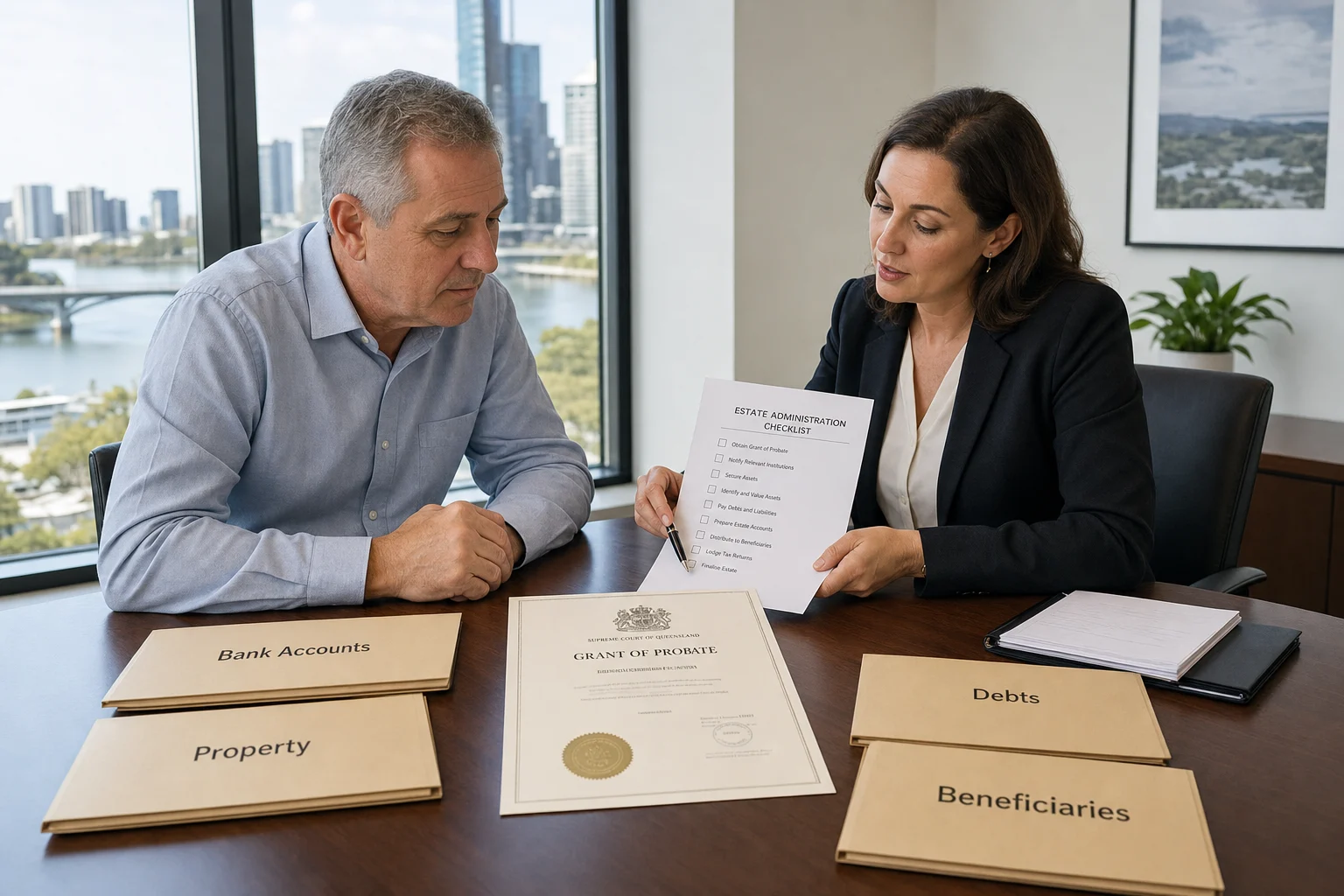
Obtaining the grant and administering the estate are separate stages. The grant can only issue after the notice periods and Registry review, while the later administration may take considerably longer because banks, asset holders, creditors and beneficiaries must each be dealt with. Executors who distribute early carry personal liability for claims and unpaid liabilities that surface afterwards, which is the main reason careful executors hold funds rather than pay out at the first opportunity.
Frequently asked questions
Can probate be granted faster in an urgent situation? There is no general fast-track for standard applications. Publishing promptly and filing complete documents are the main ways an executor can avoid preventable delay. Genuinely urgent matters, such as a property sale at risk, may warrant additional steps, which is worth discussing with a probate lawyer.
How long do we have to apply for probate? There is no strict deadline for applying, but long delay attracts questions from the Registry, and delay can expose the executor to complaints from beneficiaries who are waiting on their entitlements. Applying reasonably promptly after death is expected.
Does a small or simple estate still take the same time? The notice periods apply regardless of estate size. What changes is preparation time: a simple estate with one bank account and a clear will is quicker to document, but it still passes through the same notice and Registry stages.
What is a requisition and how much delay does it add? A requisition is a formal query from the Registry that must be answered before the grant proceeds. The delay depends entirely on the issue and how quickly and correctly you respond. A single, well-answered requisition may add a short delay; a compounding series of them can add weeks.
Do I need a lawyer to keep probate on track? You are not required to use a lawyer. Careful preparation can reduce the risk of a requisition caused by missing, inconsistent or unexplained material, although the Registry may still ask questions about an otherwise carefully prepared application.
Talk to Queensland Family Law Practice about your probate application
If you need help preparing a Queensland probate application or responding to a Registry requisition, Queensland Family Law Practice can review the will and supporting documents, explain the likely steps, and prepare the application. Our wills and estate lawyers assist executors with probate applications and Registry requisitions in Queensland, including gathering the material a requisition calls for and managing the notice steps and Public Trustee notification so the filing date is not pushed back.
Call (07) 3172 3777, email enquiries@qflp.com.au, or book a complimentary consultation to talk through your estate and a realistic timeline for it. If you only need a single question answered, our legal advice sessions cover that too.
Found this article useful? Add Queensland Family Law Practice as a preferred source and our articles will show up more often when you search on Google.