

Usually, you pay your own. In certain circumstances the court can make a costs order for one party to pay the other party's legal fees. In family law, each party generally has to pay their own legal costs, and being right does not automatically make your former partner responsible for your bill. That can be an unwelcome answer when you feel they caused the whole dispute. A costs order needs a legal basis. A convincing account of who behaved badly during the relationship is not enough.
The current general rule on legal costs in family law is in section 114UB of the Family Law Act 1975 (Cth). It replaced the old section 117, which older articles still quote. The court may depart from the general rule where the circumstances justify a costs order. Conduct during the proceedings matters, and so do financial circumstances and the other factors in the Act.
Why does each party pay their own legal costs?
It doesn't matter whether you're dealing with a divorce application, a parenting dispute or a property settlement, or whether you were married or de facto. The general rule in family law proceedings is that you fund your solicitor, you fund your barrister if one is briefed, and you pay your own court filing fees. This applies regardless of how the matter is resolved, unless the court makes a costs order requiring one party to contribute to the other party's costs.

There is a reason for the rule. Commercial litigation runs on the idea that the loser pays. Family law cases are full of contested facts and discretionary outcomes, and often nobody clearly wins. If people were penalised every time a court did not adopt their position, many would stop bringing legitimate disputes at all.
Your own legal costs include more than your solicitor's professional fees. Disbursements sit alongside them. These include filing fees paid to the Federal Circuit and Family Court of Australia, valuation fees for real property, businesses or superannuation interests, single expert report fees in parenting matters, and process servers. The court publishes its filing fees and exemption categories on its fee schedule, and the fees change every year on 1 July. Check the current schedule rather than trusting a figure you read in an article (current Federal Circuit and Family Court fee information).
In property and parenting matters, these legal fees are generally private expenses and not tax deductions. If a particular expense may relate to assessable income, ask your accountant. Don't build a tax refund into your budget without advice.
When can the court order one party to pay the other's costs?
The court may make an order for costs when it considers the circumstances justify it. Section 114UB lists what the court will consider. Those factors include the financial circumstances of each party, whether either party is receiving legal aid, conduct during the proceedings, any failure to comply with an earlier order, whether a party was wholly unsuccessful, written settlement offers and any other relevant matter (Family Law Act 1975 (Cth)). There is no automatic rule that the winner gets reimbursed.

Now, the written offer. Ask your family lawyer whether a clear, realistic offer could help resolve the dispute and protect your costs position. If the other party rejects it and does no better at the hearing, the offer may support a costs application. It doesn't guarantee one. The wording, timing and circumstances still matter.
What persuades a judge to shift costs?
Costs in family law matters turn on the section 114UB factors, so sympathy alone won't decide them. What a party did matters, and so does their financial position.
Conduct that can lead the court to order costs includes:
- Failing to give full and frank financial disclosure, so the other side has to issue subpoenas or apply to compel documents.
- Breaching existing orders, where further proceedings were only needed because of the breach.
- Not turning up to a listed event, or turning up unprepared, so a hearing date is lost.
- Running an argument with no reasonable prospects, or pressing an allegation that collapses once the evidence arrives.
- Refusing to take part in family law mediation or a court-ordered dispute resolution event without a proper reason.
Financial capacity is relevant, but it does not protect you from a costs order. The court must consider whether either party receives legal aid and on what terms. Don't assume the court can't order you to pay costs just because your income is low or you have legal aid.
If family violence or controlling behaviour affects how safely you can negotiate or take part in proceedings, tell your lawyer early. They can consider that risk when advising you about procedure, settlement offers and any costs application.
Does a costs order cover everything you have spent?
Rarely. A costs order makes one party pay some or all of the other party's legal costs, and even when you are awarded costs it seldom amounts to a full refund. Expecting otherwise sets you up for disappointment. Courts usually award costs on a party-party basis. Under that basis, the paying party covers only what was necessary and proper for the conduct of the proceedings. Those costs are assessed against the scale in the court rules, not against the invoices your lawyer actually sent you (Federal Circuit and Family Court of Australia (Family Law) Rules 2021).
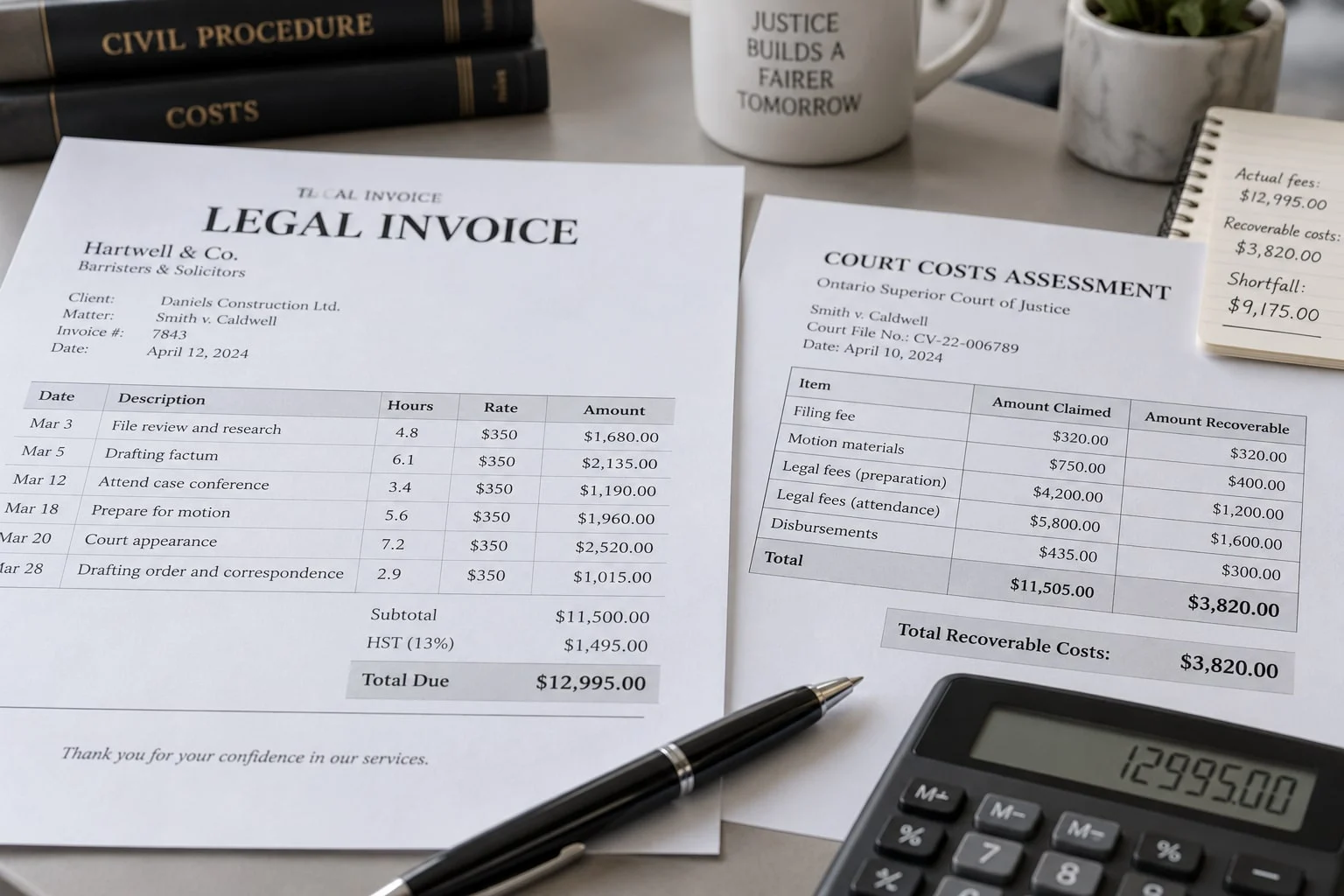
Mind the gap. If the costs incurred exceed what the scale allows, party-party costs will not cover the difference and you carry the shortfall. Indemnity costs come much closer to full recovery, but courts reserve them for genuinely serious conduct.
| Basis | What it covers | When it applies |
|---|---|---|
| Each party pays own costs | Nothing shifts | The default in the great majority of matters |
| Party-party costs | Costs necessary and proper, at the court scale | The usual basis when a costs order is made |
| Indemnity costs | Close to actual costs reasonably incurred | Serious misconduct, or an unreasonable rejection of a formal offer |
| Costs against a lawyer | The lawyer personally bears wasted costs | Where the practitioner caused costs to be wasted improperly |
A court order for costs can also cover a single step without touching the rest of the case. Suppose your former partner ignores an order and you have to file an application about it. The court may order one party to pay the costs of that application alone. That outcome is far more common than costs of the entire proceedings.
How are legal fees treated in a property settlement?
The source of the money matters. Suppose your former partner takes $40,000 from a joint offset account to pay a lawyer while you pay yours from your wages. Keep the statements and tell your lawyer, because that spending forms part of the financial history of the matter.
Don't assume the court will simply add that $40,000 back into the asset pool on paper. How spent funds are treated depends on the applicable law and the circumstances. In property settlement cases, a property adjustment and a costs order answer different questions. Ask your lawyer which, if either, applies to you.
If one party controls the available funds, ask about an interim distribution or partial property settlement to pay for representation. Neither is an automatic entitlement, and both are different from interim spousal maintenance. Find out which application fits your circumstances before you pay someone to prepare it.
What drives the size of the bill?
The hourly rate sets the price of an hour. The work required decides how many hours you buy. Two matters with similar assets can produce very different bills if one settles and the other becomes a fight over every document.
The main cost drivers are:
- Disclosure fights. Every round of subpoenas, every chase for bank statements and every application to compel documents adds hours, and usually a court event.
- Valuation disputes. A contested valuation of a business, farm or self-managed super fund can require a single expert, then questions to that expert, then cross-examination.
- Correspondence volume. Long, frequent emails between solicitors are billed. So are the ones you send your own lawyer.
- Interim applications. Every interim hearing is a small case of its own, with affidavits, submissions and preparation behind it.
- Moving the goalposts. If you change your position late, you throw away work you have already paid for.
- Trial preparation. Getting ready for a final hearing can sharply increase costs. Your lawyer has to assemble the evidence, prepare submissions, brief counsel where required and get the case ready to run.
The path you choose makes a big difference. Consent orders reached after mediation usually take far less legal work than a fully contested final hearing.
Can you get legal aid or reduced court fees?
Both exist, and both have rules. Legal Aid Queensland grants aid for some family law matters, subject to means and merit tests. It gives priority to matters involving children and to parties affected by family violence (Legal Aid Queensland family-law funding guidelines). Aid has limits. Grants are made in stages, and a grant may cover a dispute resolution conference but not a final hearing.
Court fees are a separate question. The Federal Circuit and Family Court has a reduced fee provision for categories such as holders of certain government concession cards, people receiving youth allowance or Austudy, people under 18, people in prison or lawful detention, and people granted legal aid. There is also a general financial hardship provision, which the court assesses on application. The categories and the form are on the court's website (current Federal Circuit and Family Court fee information). Apply before you file, or when you file. Refunds after the event are much harder to get.
Which parts of the bill can you control?
You can't control your former partner's choices. You can control your instructions, the documents you provide and how you send your questions. Start there.
- Gather disclosure once and gather it properly. Ask which date ranges apply, then put together your tax returns, account statements, superannuation statements, loan documents and any other records your lawyer asks for.
- Group your non-urgent questions to avoid repeated file handling. Don't hold back an urgent issue just to send fewer emails.
- Find a support person for the emotional load. Lawyers' time is expensive.
- Ask about making a realistic written offer early. It may help settle the matter and support a later costs argument. It does not cap what you might have to pay.
- Consider mediation before positions harden, where it is safe and appropriate.
- Read your costs agreement, all of it. That includes the hourly rate of every person who might work on your file and the estimate of total costs.
Talk to us before the costs decide themselves
Ask about costs before the letters start multiplying. What work is necessary? What could settle now? What would change the estimate? We can work through those questions and your funding options with you.
Call (07) 3172 3777, email enquiries@qflp.com.au, or book your consultation to discuss your costs position and your options.
Found this article useful? Add Queensland Family Law Practice as a preferred source and our articles will show up more often when you search on Google.