

If two people own the property as joint tenants, the survivor becomes the sole registered owner when the other dies, regardless of what the deceased owner's will says. If there are more than two joint tenants, the deceased owner's interest accrues to the surviving joint tenants. Tenants in common are different: each owner has a defined share that can pass under their will. Separation changes neither. That is why plenty of separated people who bought property together are still holding a title that quietly works against what they now want.
How do joint tenants and tenants in common actually differ?
With a joint tenancy, survivorship decides who ends up with the property. A tenant in common can leave their share to anyone, and the executor deals with it like any other asset.
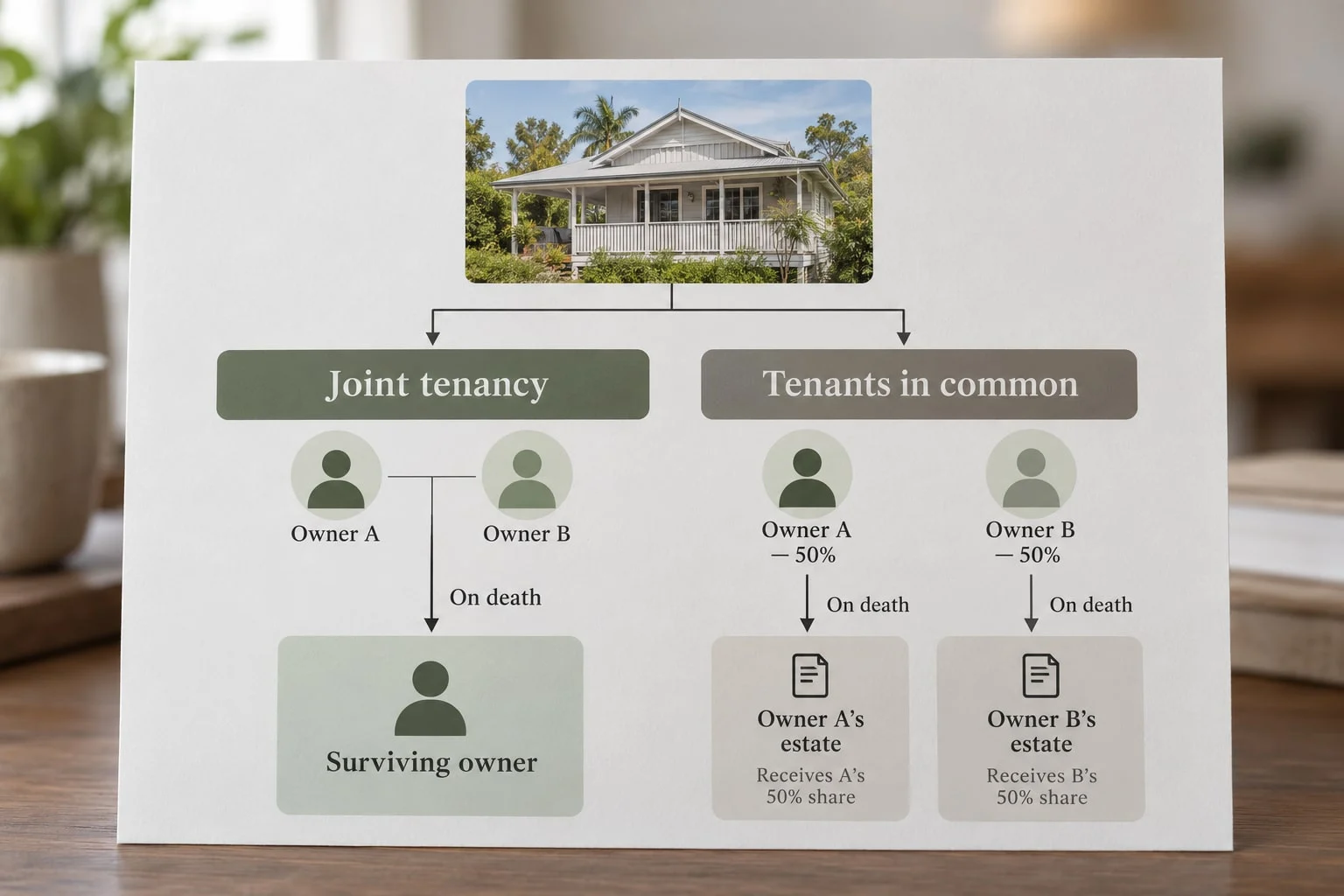
Tenants in common can be registered in unequal shares, such as 70/30. Those fractions must appear on the title. A larger deposit does not automatically create that ownership split, and it does not dictate the eventual family-law settlement.
Which one do you hold?
Start with a current title search from Titles Queensland. It will say either "joint tenants" or "tenants in common", and for the second it will show a fraction against each name.

Does the form of ownership decide who keeps the house when you separate?
No. Under the Family Law Act, the court looks at the whole pool of assets and liabilities, each person's contributions, and what each will need going forward. Title is one piece of evidence about contributions. It is not the answer. A one-third tenant in common can walk away with far more than a third, and a joint tenant with less than half. Our guide to what happens in a property settlement explains the steps, and the same framework applies to de facto couples.
What happens if an owner dies before the settlement is finished?
Three facts decide it: how the title was registered at death, whether property proceedings had already started, and whether an agreement, order or earlier dealing had altered the parties' legal or equitable rights.

The joint-tenancy column assumes two owners.
| Stage | Joint tenancy | Tenants in common |
|---|---|---|
| Separated, nothing filed or agreed | The property passes to the survivor outside the estate. Any equitable claim is a separate question | Share passes under the will. If there is no will, intestacy rules decide, and a spouse or children may benefit |
| Negotiating or in court, no orders made | The survivor takes the property by survivorship. If property proceedings were already underway, the court may allow the deceased party's legal personal representative to continue them where the statutory conditions are met. Section 79AA(8) of the Family Law Act applies to married-couple proceedings; de facto matters require the corresponding de facto property provisions to be checked. An estate generally cannot cure the problem by starting ordinary property proceedings only after the party has died | The registered share forms part of the estate. If property proceedings began before death, the legal personal representative may seek to continue them under the applicable statutory provision |
| Consent orders signed but not yet made by the court | Survivorship can still apply because the transfer has not happened, though the signed terms may matter. This is the danger zone | The share sits in the estate until the orders are made and the transfer is done |
| Orders made, transfer not yet registered | The orders may bind the estate, but survivorship can complicate the registration | The estate has to complete the transfer the orders require |
Until a transfer is registered, an earlier agreement, order, contract or course of dealing can still affect the parties' equitable rights. Our page on consent orders in Queensland covers why this window exists and how to keep it short.
What does this mean for your will?
A will cannot redirect an interest that passes by survivorship. If the property is still jointly held when you die, the surviving joint tenant takes that interest outside the will. Blended families feel this most, because the survivor may not be the parent of the deceased's children.
For married couples, separation alone does not revoke gifts or appointments for your spouse. Section 15 of the Succession Act 1981 (Qld) generally operates when the divorce takes effect, and separation versus divorce covers when that can happen. Queensland law contains separate provisions for the end of a de facto relationship, including section 15B, so former de facto partners should have the will reviewed against the way and date the relationship ended. Either way, update the will yourself. An automatic rule is a poor thing to rely on.
Survivorship property also sits outside the estate, so a family provision application usually cannot reach it. Read contesting a will for how those claims work.
Should you sever the joint tenancy now or wait?
If the relationship is over, your will directs the property elsewhere and no settlement transfer is close to registration, severance deserves prompt attention. Waiting can make sense if reconciliation is genuinely possible or a binding transfer is about to be completed.
A simple severance does not necessarily change the debt under your home loans or the beneficial proportions. That does not make lender, duty or tax consequences irrelevant. Before lodging the transfer, have the instrument checked and confirm what severance means for the loan, the duty and your tax position.
- You lose survivorship. If your ex-partner dies first, their share goes to their estate and you may have to negotiate with whoever inherits.
- You gain control. Your share goes to the people you choose.
What the law requires before you sever a joint tenancy
- Sign a transfer as the registered owner. Under s 59(1) of the Land Title Act 1994 (Qld), you can sever a joint tenancy on your own by registering a transfer you have executed. The other owner's agreement is not required.
- Give notice to the other joint tenants before you lodge. Notice is a precondition to registration. Under s 59(2), the registrar must be satisfied you have given, or made a reasonable attempt to give, notice or a copy of the instrument to the other joint tenants. Skip this and the transfer does not register.
- Hold equal shares after the change. The Queensland Revenue Office's s 143 exemption exempts a change from joint tenants to tenants in common from transfer duty only where the owners hold equal shares afterwards and no co-owner's interest changes in value. Unequal shares, and the exemption is gone.
- Check what registration actually does. Once registered, s 59(3) makes you a tenant in common with the other owners. Survivorship ends for your interest, and your share falls under your will.
- Fix the will, and know what divorce does to it. Section 15 of the Succession Act 1981 (Qld) revokes gifts and executor appointments in favour of a former spouse on divorce, not separation. And for this purpose, s 15(5) ties "divorce" to a divorce order taking effect under the Family Law Act 1975 (Cth) or a recognised overseas dissolution. Until that order takes effect, your separated spouse remains a beneficiary.
The step that matters most is the notice precondition, because it is the one that can quietly sink the whole exercise. Severance feels like a private decision you make alone, and legally it is, right up until the registrar asks whether the other joint tenants were told. A transfer lodged without notice, or without a reasonable attempt at it, sits unregistered, which means survivorship is still alive and your estate plan still points at the wrong person. Get the notice done, keep proof of the attempt, and the rest of the checklist falls into place.
What we see when joint tenants separate
In our experience, clients who don't complete a formal property settlement are more likely to have this problem. A formal property settlement will always seek to have any joint assets retained by one party or sold, with the proceeds distributed according to the settlement. Joint property is just one of the risks of not completing a formal property settlement. It gets harder to deal with the longer it is left unattended, because you have to give notice to the other joint tenant when you later seek to sever the tenancy.
What else should you check on the title?
Bankruptcy. If one of the joint tenants becomes bankrupt, the joint tenancy ends and their share passes to the trustee.
Time limits. For a married couple, you have 12 months from the date a divorce takes effect to start property proceedings, and for de facto couples it is 2 years from separation (Family Law Act 1975 (Cth) s 44). Our property settlement time limit page covers the exceptions.
What should you do this week?
Order your title search. Read your current will, and check who it names as beneficiary and executor. If you hold the property as joint tenants and are separated, get advice on whether to sever before you do anything else. Our guide on how to prepare for property settlement lists the other documents to gather.
Queensland Family Law Practice assists clients across Brisbane, the Sunshine Coast and the Gold Coast. To discuss your title, estate plan or property settlement, contact Queensland Family Law Practice, email enquiries@qflp.com.au, or read about our property settlement lawyers.
Found this article useful? Add Queensland Family Law Practice as a preferred source and our articles will show up more often when you search on Google.